MAD / 02 — Figini e Pollini
Casa Figini Pollini
An urban, rational apartment where lines, proportions and materials interpret contemporary Milan.
Booked nights are crossed out

An urban, rational apartment where lines, proportions and materials interpret contemporary Milan.
Booked nights are crossed out
01 Gallery
02 Amenities
 Self check-in
 Wi-Fi
 Coffee corner
 Cleaning
 Wardrobe
 Assistance
 Stay support
 Central location
Main amenities available on request or to be confirmed.
03 The building
An exclusive address where architecture, art and history merge in one of the most refined works of post-war Milan.
The apartment is set in one of the most representative buildings of post-war Milan, designed by Luigi Caccia Dominioni between 1953 and 1959 to replace the bombed buildings between Corso Europa and Via Durini.
While the Corso Europa front is defined by the lightness of its rhythmic aluminium window framing, on the Via Durini front the architect adopts a more material language: a rigorous grid of square windows set into a stone-clad façade with a marked rusticated texture, where geometric precision dialogues with the richness of the surface.
In the gallery connecting the two streets, the rigour of the façades gives way to a surprising fluidity: here Caccia Dominioni designed a covered walkway, recalling the nineteenth-century tradition of the passage. The soft forms are accentuated by curved crystal shopfronts alternating with sinuous Venetian-stucco partitions.
Completing this vision is the magnificent mosaic floor by maestro Francesco Somaini, made of polychrome marble in an abstract design that accompanies visitors’ movement. The collaboration between Caccia Dominioni and Somaini makes Galleria Strasburgo an emblematic example of the integration of architecture, art and public space.
04 The apartment
Rigour, rhythm and function: the space follows a modernist logic, where every element has a precise reason.
The legacy of Figini and Pollini, leading figures of Italian Rationalism, can be read in the grid of the spaces and the sobriety of the materials. An urban, essential interior built on rhythm.
In Galleria Strasburgo, between San Babila and the fashion Quadrilatero, the apartment is the ideal base for experiencing the Milan of design and business.
CIN IT015146B4TWXTGMID · CIR 015146-CIM-12809
Legal information
05 The artworks

White Brick, 2023
Photograph on paper
A contemporary Egyptian photographer, Mohamed Zad (Cairo, 1984) focuses his work on the human and industrial landscapes of the Middle East, exploring the relationship between labour, environment and identity. Through a rigorous black-and-white language, his images turn everyday scenes into compositions of intense narrative power.
White Brick portrays a brick kiln in Egypt, wrapped in an atmosphere suspended between reality and vision. The light does not simply illuminate the scene, it becomes its true subject: beams filter through smoke and dust, sculpting the workers’ figures in a refined play of backlighting.
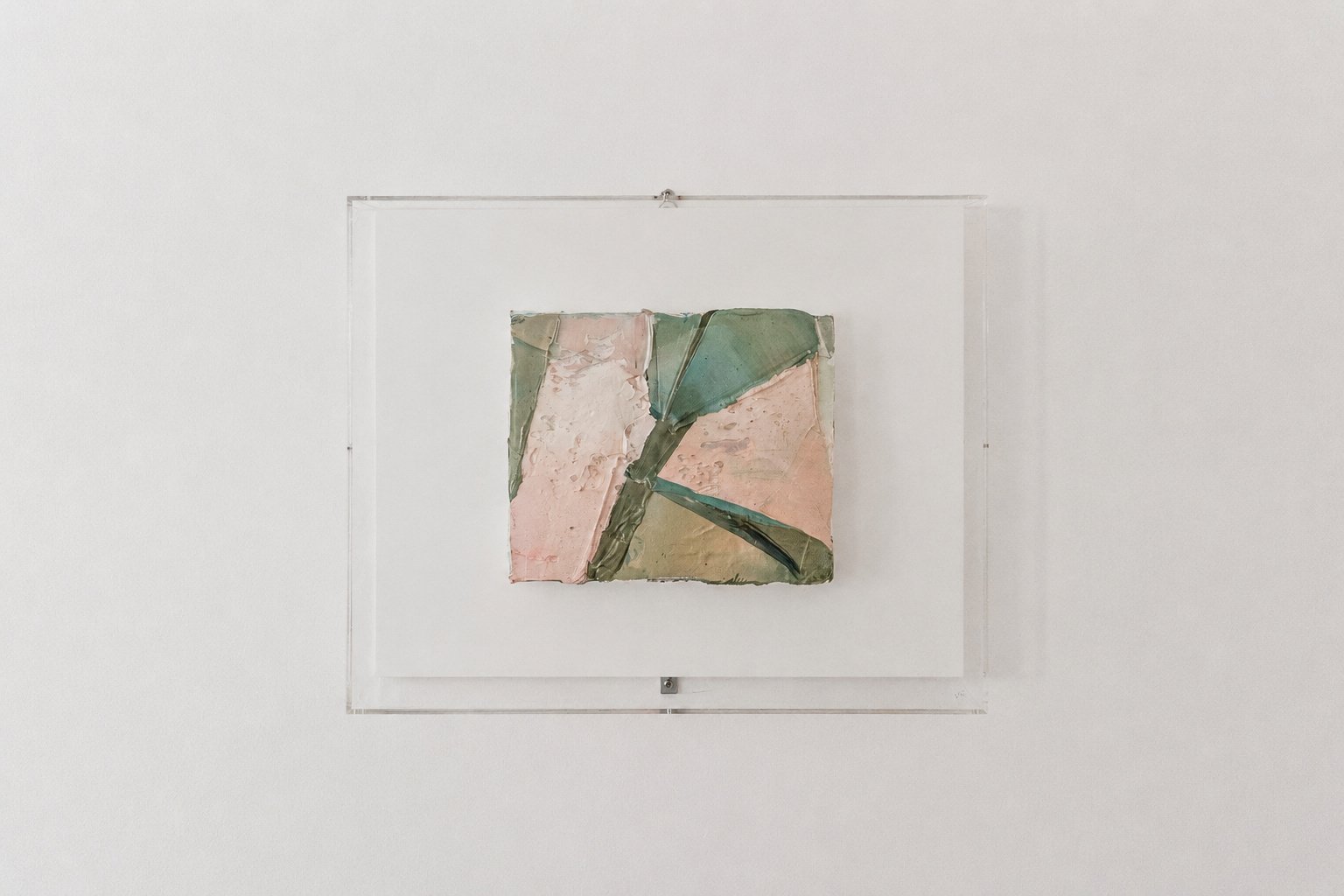
Labio vegetal, 2018
Olio su lino, 27 × 22 cm
Mercedes Mangrané (Barcellona, 1988) è una delle voci più interessanti della giovane pittura contemporanea spagnola. Vive e lavora a Barcellona, dove sviluppa una ricerca che si colloca al confine tra astrazione e figurazione, ispirata all’osservazione ravvicinata di superfici, muri, infrastrutture urbane e dettagli apparentemente insignificanti della vita quotidiana.
In Labio vegetal Mangrané utilizza una tavolozza ridotta di verdi, rosa pallido e grigi, costruendo una composizione che sembra nascere dalla tensione tra materia pittorica e forma. Le dense stesure di colore, applicate con spatola, si piegano e si sovrappongono creando rilievi che rendono la superficie quasi scultorea.
Il titolo, labbro vegetale, suggerisce una lettura organica dell’immagine: ciò che inizialmente appare come una composizione astratta richiama progressivamente membrane, foglie, pieghe della pelle o frammenti di paesaggio osservati da vicino. Questa ambiguità è uno degli aspetti centrali della ricerca dell’artista, che evita la rappresentazione diretta per evocare sensazioni fisiche e percettive.
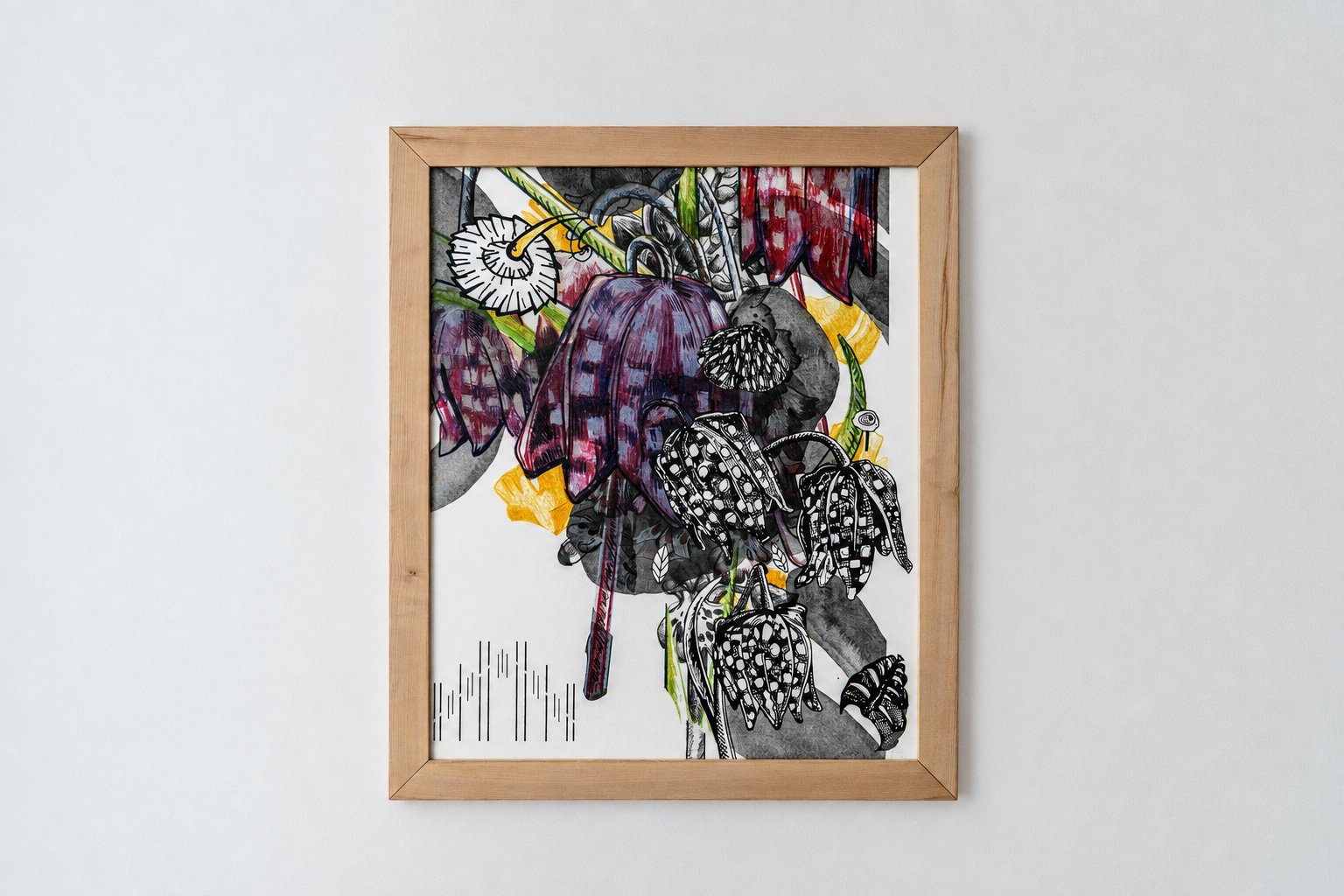
Untitled, 2018
Digital print
Florentine (Rosenheim, 1978) and Alexandre (Le Coteau, 1980) Lamarche-Ovize are a French artist duo who have worked together since 2006, with a multidisciplinary practice inspired by the plant and animal world, natural history and scientific illustration.
The composition is dominated by a dense weave of botanical elements — flowers, seed pods and foliage — poised between scientific observation and imaginative freedom. The plant forms are enlarged, fragmented and recomposed into a dynamic structure, where transparencies and overlapping colours create a sense of continuous transformation.
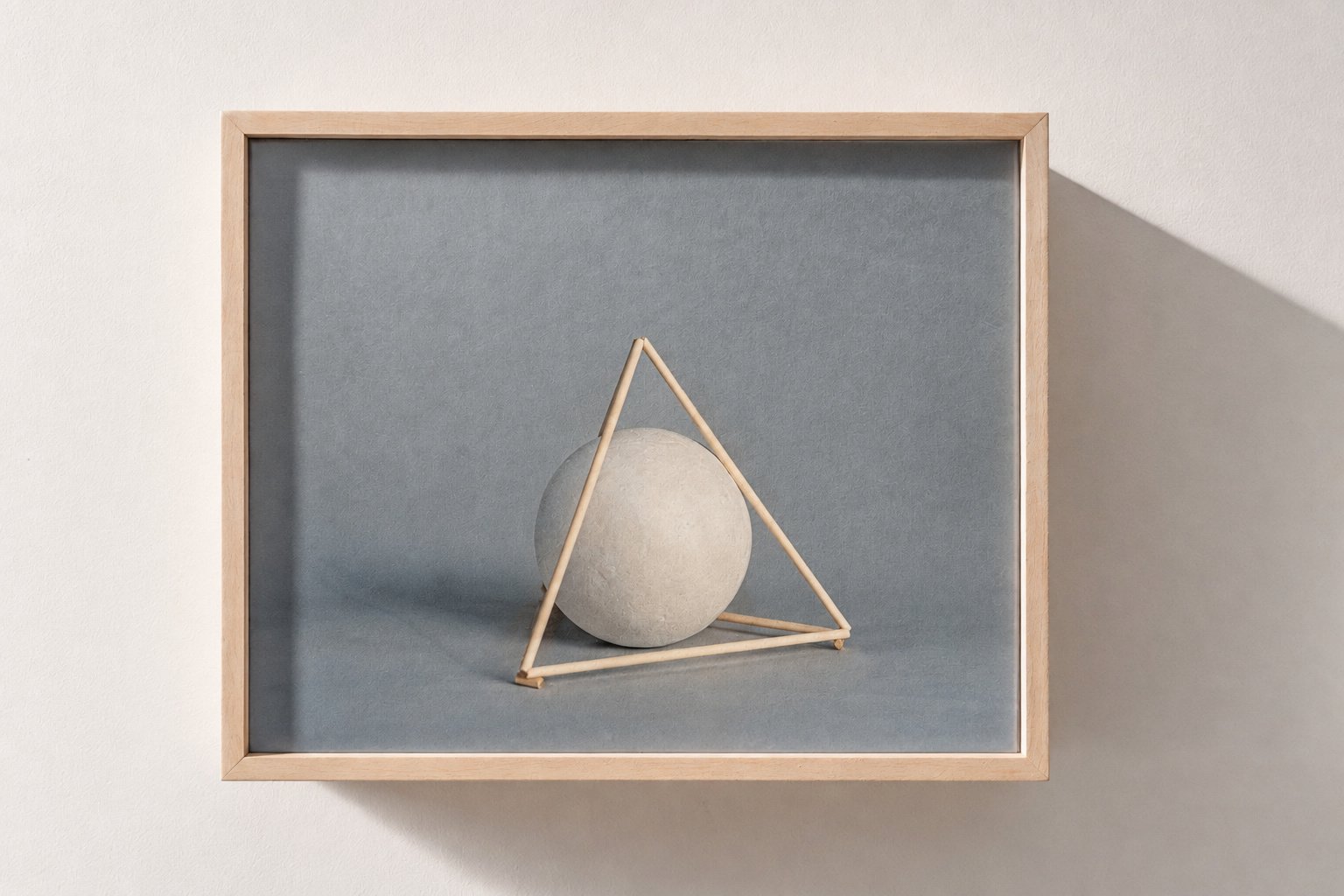
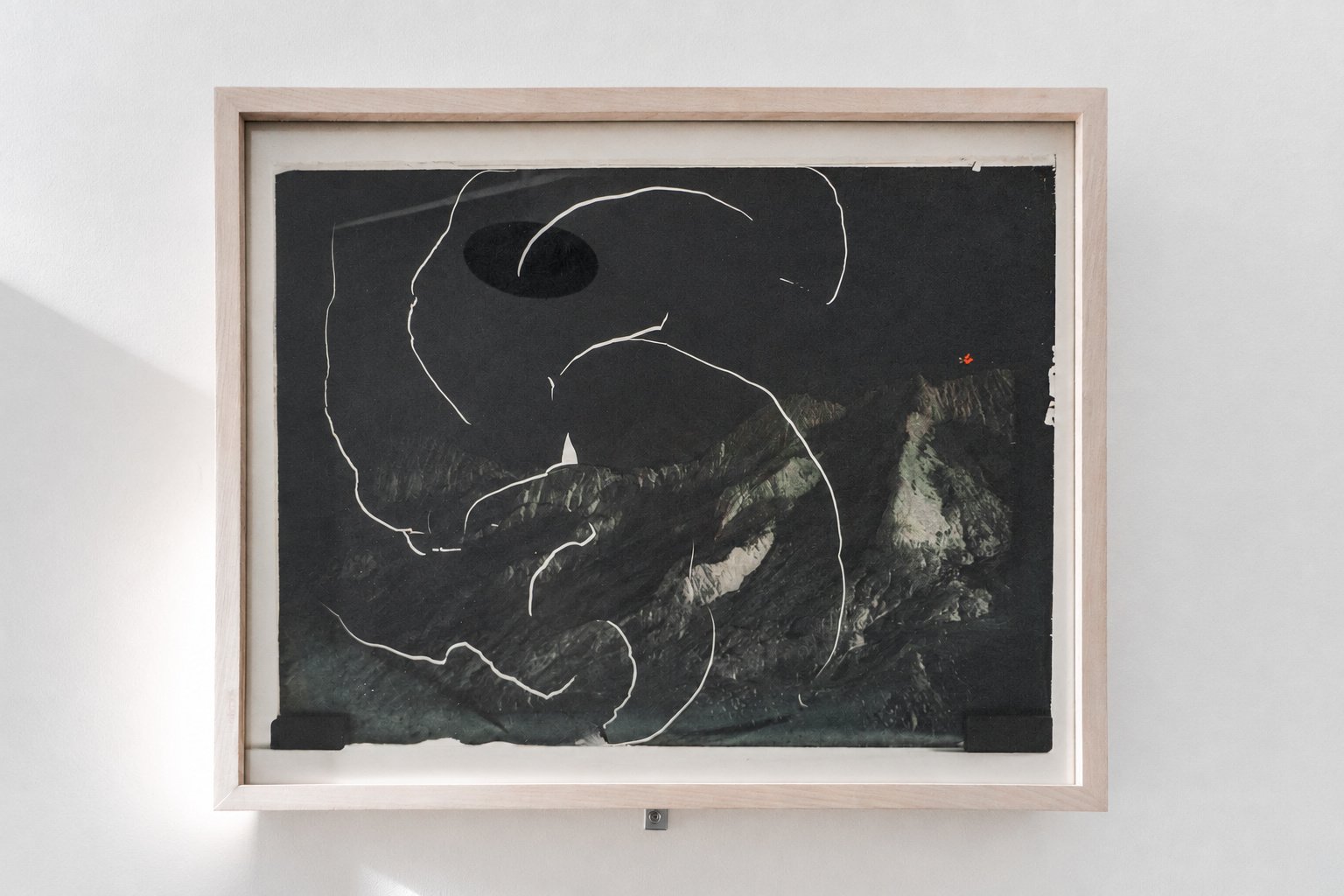
#01 and #19, from the series Entre chien et loup, 2019–2020
Canson Platine Fibre Rag paper on Alu-Dibond
Marina Caneve (Belluno, 1988) is an Italian photographer and visual artist whose work moves between photography, scientific enquiry and reflection on landscape. The diptych belongs to the series Entre chien et loup, made from the archives of the Museo Nazionale della Montagna in Turin: the title takes up the French expression for twilight, when the light no longer allows a dog to be told from a wolf — a metaphor for the threshold between knowledge and doubt.
The two images speak to each other as complementary poles: the sphere enclosed in the triangular structure recalls the perfect geometry of the Matterhorn reduced to its essence as an icon, in a balance that is only apparent and hints at the vulnerability of the mountain landscape; the image crossed by thin white lines evokes geological layers, fractures in the rock, the traces of time.
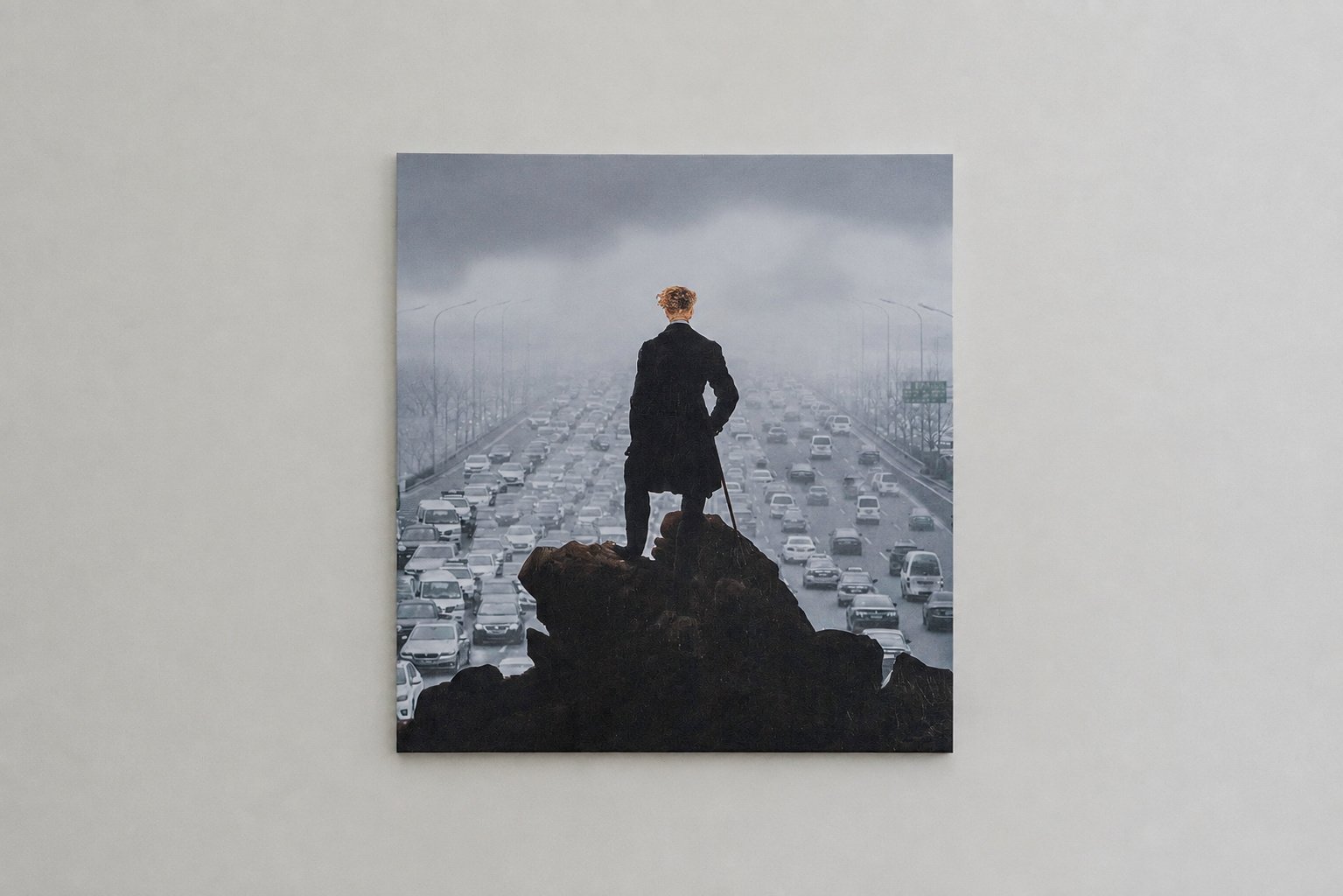
Il Viandante sulla Tangenziale, 2018
Photographic print on aluminium
Antonio Torretti is a visual artist trained at the Brera Academy of Fine Arts. His work grows out of the observation of everyday life and uses photography, digital manipulation and the blending of images to reflect on the contradictions of contemporary society.
The work reinterprets one of the most iconic subjects of Romantic painting — Caspar David Friedrich’s Wanderer above the Sea of Fog — replacing the sublime natural landscape with a ring road clogged with traffic. The solitary figure keeps the contemplative pose of the original, but the panorama is that of urban mobility: a subtle critique of modernity entrusted to irony and visual short circuit.
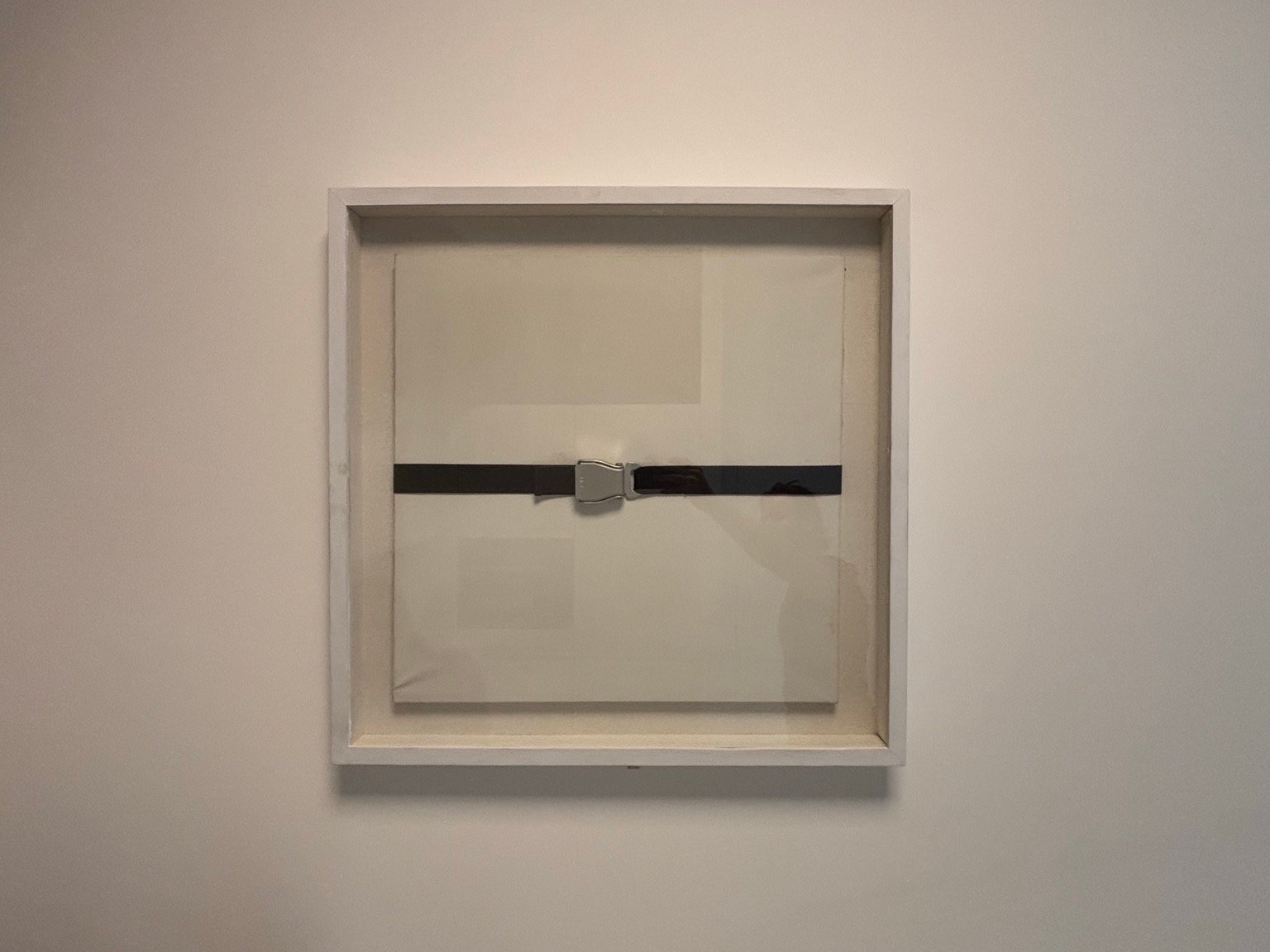
Allacciate le cinture, 2015
Mixed media on canvas
Francesco De Molfetta (Milano, 1979), noto anche con l’acronimo DEMO, è tra gli artisti italiani più originali della sua generazione. La sua ricerca si sviluppa attraverso scultura, pittura e installazione, combinando iconografia pop, cultura di massa, storia dell’arte e immaginario contemporaneo. Le sue opere sono caratterizzate da un linguaggio ironico e dissacrante che, dietro l’immediata leggerezza, affronta temi più profondi quali il consumismo, la spettacolarizzazione della società e il rapporto tra realtà e rappresentazione. L’umorismo diventa così uno strumento critico, capace di trasformare oggetti comuni e immagini familiari in riflessioni sulla condizione contemporanea.
In Allacciate le cinture De Molfetta porta all’estremo la riduzione del linguaggio visivo. Il titolo suggerisce immediatamente il consueto invito pronunciato prima di un decollo, ma qui l’azione dell’allacciare le cinture assume un valore ambiguo. Da un lato, invece di fissare una persona, la cintura “assicura” due lati di un quadro: un gesto apparentemente inutile e privo di significato. Dall’altro diventa una metafora dell’esigenza umana di trattenere, controllare e dare stabilità a ciò che, per sua natura, è vuoto, instabile o privo di significato.
L’opera si colloca in una dimensione sospesa tra il ready-made duchampiano, il rigore minimale e una sottile atmosfera metafisica. L’oggetto reale invade lo spazio della pittura, ma non ne annulla il silenzio; al contrario, lo accentua. Lo spettatore è portato a interrogarsi se ciò che osserva sia un quadro, un oggetto o una sorta di paradosso visivo.
Come spesso accade nella produzione di De Molfetta, il sorriso costituisce soltanto il primo livello di lettura. Dietro l’apparente semplicità emerge una riflessione sul bisogno di attribuire senso alle cose e sulla fragilità degli equilibri che costruiamo. La cintura non protegge realmente nulla: trattiene soltanto il vuoto, trasformando un gesto ordinario in un’immagine al tempo stesso ironica, concettuale e sorprendentemente contemplativa.
The works belong to the private collection living in the apartment.
06 Location
Galleria Strasburgo links the centre to San Babila, in the commercial and architectural heart of Milan: minutes from the Duomo, Montenapoleone and the metro.
The exact address and access instructions are provided after the request is confirmed.

Move the map with two fingers.
07 Request
Fill in the essential details of your stay. We'll reply via WhatsApp or email with availability, details and conditions.